
With more than 60 startup pilots since 2018, Uppsala Municipality has made innovation part of how it operates. Through clear leadership, practical support and a long-standing partnership with Ignite Nordic, the city is showing how public organizations can turn everyday challenges into opportunities for collaboration.
For many public organizations, turning promising innovations into lasting improvements remains a challenge. Uppsala Municipality has developed a systematic approach to identifying needs, connecting with startups and testing solutions in real-world environments.
At the heart of this approach is the Uppsala Model, an innovation framework developed through a long-standing partnership with Ignite Nordic. By combining clear political mandates, proactive procurement practices and a culture of experimentation, the municipality has made startup collaboration an established part of its operations.
“Everything starts with a first collaboration, and everything starts with a need,” says Annika Remaeus, Head of unit Business and development at Uppsala Municipality.
Making Innovation Part of the Organization
Uppsala Municipality’s journey began in 2018, when its Culture Department became one of the first to explore collaboration with innovative startups through the project Ignite Public. Since then, the approach has spread across municipal departments and companies, resulting in more than 60 startup pilot projects.
A key success factor has been combining engagement from employees with strategic support from leadership. Startup collaboration is now included in the municipality’s governing documents, while dedicated resources help departments identify needs, navigate procurement requirements and initiate collaborations.
“Working with innovative companies is part of our mission. In many ways, they serve as an external R&D department for the city, while we offer them a testbed in real-world environments. Having it in our governing documents is important, because it provides continuity,” Annika explains.
To address common barriers, Uppsala involves procurement, legal and IT experts early in the process, including during startup matchmaking meetings. This allows employees to focus on solving challenges rather than navigating unfamiliar procedures.

Many pilots can also be structured within direct procurement limits, enabling smaller-scale tests before broader implementation.
However, creating time for innovation alongside everyday public services remains a challenge.
“Mobilization isn’t something you do once and then finish. It’s an ongoing process of identifying administrative barriers and protecting the time needed for innovation.”
From Pilot Projects to Real-World Impact
Uppsala Municipality’s approach has produced results across public services, housing and tourism, with several collaborations facilitated through Ignite Nordic.
Parlametric tested AI-powered analysis to gather citizens’ perspectives on public safety around Uppsala Central Station, supporting better-informed decisions about the urban environment.
At municipal housing company Uppsalahem, a pilot with Mimbly tested technology for reducing water consumption and filtering microplastics from laundry wastewater. The collaboration later expanded to 11 communal laundry rooms.
Destination Uppsala partnered with Exenze to develop a location-based digital experience featuring the children’s character Pelle Svanslös. The pilot attracted 750 active players and developed into a longer-term commercial relationship.
Another example is Daily Innovation, whose solution for measuring organizational innovation capabilities was initially tested on a small scale. It was later expanded and procured through a framework agreement covering 1,800 employees at the Municipal Executive Office.
Together, these examples show how small-scale experiments can address different public sector needs and, in some cases, develop into lasting solutions. But scaling up is only one possible outcome. In Uppsala’s view, an experiment never fails as long as it leads to learning. It may result in internal change and development, make the municipality a better-informed buyer in regular procurement, or lead to a solution being scaled up and procured to meet the original need.
A Partnership That Builds Confidence
Uppsala Municipality has partnered with Ignite Nordic since 2019. Beyond connecting the municipality with relevant startups, Ignite Nordic’s matchmaking process and facilitation have helped establish a structured way of exploring new solutions.
For an organization with approximately 18,000 employees, having a clear process and access to experienced support makes startup collaboration more accessible to departments trying it for the first time.
“It’s a privilege to work on these issues together with Ignite Nordic and with the support of the process, because it provides the confidence that’s needed,” Annika says.
Since 2019, the municipality has won seven Ignite Awards for their startup collaboration efforts. One of the most significant came in 2024, Uppsala Municipality, Uppsalahem and Destination Uppsala were jointly recognized as Ignite Hero of the Year, acknowledging their commitment to innovation across the public sector.
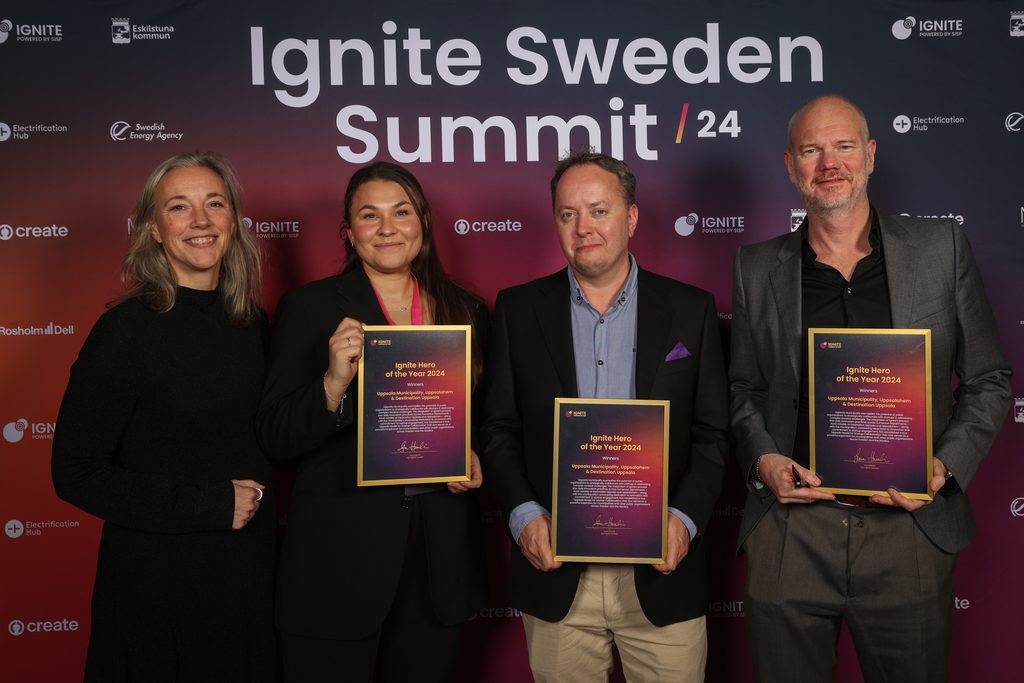
A Culture of Continuous Learning
Despite its progress, Uppsala Municipality continues to face challenges in engaging new departments and creating room for development alongside everyday responsibilities.
For Annika, sharing experiences and communicating both successes and difficulties is essential to maintaining momentum.
“There’s a lot of communication and storytelling involved. And you shouldn’t shy away from what’s difficult, because that’s where there’s knowledge to be gained.”
By making lessons from individual pilots visible throughout the organization, Uppsala encourages more departments to explore collaboration with innovative companies.
The municipality’s experience shows that successful startup collaboration requires more than access to new technology. It takes leadership, practical support and a willingness to keep learning.
And sometimes, it all starts with identifying a need and finding the right partner to solve it.
When Ignite Nordic matched Parlametric with Uppsala Municipality in 2019, it opened the door to a market the startup had not originally set out to focus on. Today, public organizations are at the heart of Parlametric’s business, using its language analysis and AI technology to turn everyday conversations into data that supports better decisions and services.
Through 66 tailored one-to-one meetings facilitated by Ignite Nordic, Parlametric has initiated 22 collaborations with 15 different organizations. These connections have helped the company find its niche, build valuable customer references and create opportunities for continued growth.
Looking Beyond the Numbers
Parlametric’s story began as a research project at Lund University in 2017, built around a simple problem with traditional surveys: a number rarely tells you the whole story.
“The idea was to start analyzing free-text responses and only work with open questions, so that surveys could become more like an in-depth interview,” says Rebecka Komét, Business Developer and Public Sector Account Manager at Parlametric.
The company developed its own method for language analysis and applied the latest applicable AI technology to it. Over time, the original idea evolved from analyzing feedback after an interaction to learning from the interaction itself.
“We developed the idea further through the collaborations we had and the requests we received. Instead of sending out a survey after a conversation, we could analyze what was actually said in the interaction and turn that into statistics.”
Today, that conversation analysis is Parlametric’s main service.
Turning Conversations into Data
For municipalities and public housing companies, thousands of interactions through phone calls, emails and chats contain information about what people need, where processes create friction and what could be improved.
For recorded calls, audio is transferred through encrypted channels before being transcribed and anonymised. AI analyses the content and identifies subjects, questions and recurring issues, which can then be aggregated into statistics. A recurring problem mentioned in individual conversations can thereby become information an organization can act on.
“Our service combines language analysis and AI technology with human analysts who carry out quality controls,” Rebecka explains.
That human-in-the-loop approach has been part of Parlametric’s development from an early stage.
“We were quite early with AI, and we learned pretty quickly that if you let AI decide everything on its own, it will go off the rails. So quality assurance has been a very important part of our service, both to ensure good results and to create solutions adapted to the customer.”

A Meeting That Opened a New Market
As Parlametric moved from research towards commercialization, it was still exploring where its technology could create the most value. A meeting with Uppsala Municipality, facilitated by Ignite Nordic in June 2019, became an important step towards the company’s future specialization.
“By matching us with public organizations, Ignite made it easier for us to reach potential customers,” says Rebecka. “Especially in the beginning, Ignite also became a kind of quality stamp. It can be difficult for an organization to take a chance on a company that does not yet have many references.”
The connection with Uppsala Municipality led to several projects and gave Parlametric valuable references. It also helped the company recognize the opportunities of focusing on public-sector organizations.
“It meant that we could start having customers as references and build from there. We realized that if we wanted to become really good at this, we needed to focus on a particular target group. We chose the public sector.”
But choosing a sector and understanding how to operate within it were two different things. Public procurement brought strict requirements and long sales cycles, while analyzing interactions between citizens and public-sector employees meant navigating extensive legal, privacy and security requirements.
“A municipality or region also has a responsibility towards its citizens. There have been many security checks and quality reviews to show that we meet all the requirements, and to help municipalities move forward with their risk and impact assessments.”
Meeting those requirements became part of learning what it takes to move from individual projects towards long-term customer relationships.
When One Collaboration Opens the Next Door
The Uppsala meeting was the beginning of a much broader network of connections. Of the 22 collaborations Parlametric has initiated through Ignite Nordic, 20 have been with public-sector organizations, involving 13 different organizations.
Parlametric’s work with public housing company Kopparstaden is one example of how those connections have created long-term value. The two were introduced through Ignite Nordic in 2021, and their collaboration has expanded from surveys and free-text analysis to AI-based analysis of customer service interactions.
“Kopparstaden was one of the first housing companies we started working with, and they have been a very important reference for us,” says Rebecka.
Together with collaborations such as those in Uppsala, the relationship helped Parlametric establish credibility and demonstrate the relevance of its offering to other public organizations.
“As a startup, it is easy to get stuck being seen as an exciting company with a cool service that someone just wants to test on a small part. For us, it has been important to understand how their entire organization works.”
For Rebecka, scalability is another important part of the equation.
“If you have established a collaboration with one municipality, there is an opportunity for three other municipalities to want to join in on the same thing.”
By connecting Parlametric with organizations facing similar challenges, Ignite has helped create opportunities for the company to build on its early collaborations rather than starting from scratch with every new customer.
Shaped by the Needs They Encountered
IThe relationships Parlametric developed also helped reveal new applications for its technology.
An important turning point came through a collaboration with Skövdebostäder. Parlametric had approached the company with its survey offering, but the customer raised another question: could Parlametric analyze customer interactions instead?
The original ambition to understand what people actually mean rather than reducing their experiences to a number remained, but the source of those insights had expanded from survey responses to conversations already taking place every day.
From Startup to Specialist
The evolution of Parlametric has also been reflected in the company’s rapid growth, supported by an expanding customer base and a clearer focus on the public sector.
“Things have moved very quickly. We have expanded, we are moving offices and hiring more people.”
But the next phase is not simply about becoming bigger. With a growing number of customers across the public sector, Parlametric wants to deepen its understanding of the specific industries and organizations it serves.
“Now that we have such a large collection of different industries and organizations within the public sector, we need to focus even more on becoming specialists within those industries, so that what we provide becomes even more useful to them.”
For Parlametric, the connections made through Ignite Nordic have helped shape more than its customer base. They have contributed to a clearer market focus, provided important references and opened doors to relationships that continue to create opportunities for growth.
What began with an introduction to Uppsala Municipality through Ignite Nordic in 2019 has become part of a much larger journey, showing how the right connections can help a startup find its place in the market.
Meet Christoffer Eldskott, CEO of LumberScan, as he shares how a match through Ignite Nordic transformed the company’s international growth strategy.
As part of Science Week & Sveriges Innovationsriksdag 2025, Ignite Nordic hosted a series of interviews exploring how startups turn innovation into commercial collaboration with Swedish and international corporations. The conversations are hosted by Maria Olofsson, VP Ecosystems at Ignite Sweden.
In this interview, Christoffer Eldskott explains how LumberScan helps sawmills, pulp mills, board factories, and biofuel plants perform fast, transparent, and accurate inventory management using drone technology.
Expansion to North America Thanks to Ignite Match
When the company was founded, the plan was to grow gradually across the Nordic region, starting with Sweden and Finland before eventually considering international expansion. That strategy changed when Ignite Nordic connected LumberScan with a Canadian forestry company.
The collaboration evolved into a long-term commercial collaboration that ultimately led the company to establish a subsidiary in Montréal and make North America one of its key growth markets. Today, the collaboration is being rolled out across multiple production sites.
The opportunity revealed a much larger market than the startup had anticipated and prompted a strategic shift toward North America. According to Christoffer Eldskott, without that match, the company would likely not have entered the North American market when it did.
Watch the full interview below to learn more about LumberScan’s journey.
Meet Johan Weidolf Nyström, COO of Librixer, as he shares how a collaboration through Ignite Nordic led the company into new industries.
As part of Science Week & Sveriges Innovationsriksdag 2025, Ignite Nordic hosted a series of interviews exploring how startups turn innovation into commercial collaboration with Swedish and international corporations. The conversations are hosted by Maria Olofsson, VP Ecosystems at Ignite Sweden.
In this interview, Johan Weidolf Nyström explains how Librixer has developed a machine that can liberate materials in a more efficient way, reducing waste and enabling higher-value outputs. Originally focused on the food industry, the technology helps improve production processes by extracting more value from raw materials while minimizing waste.
Librixer’s journey took a new direction through Ignite Nordic’s matchmaking process, when they were connected with a major mining company from Brazil. This revealed a completely new application for their technology. By applying their solution to mining waste, Librixer demonstrated how additional value could be extracted from existing materials, reducing the need for further resource extraction and lowering environmental impact.
This collaboration opened up a new market for Librixer, expanding its focus beyond food into mining and recycling. Today, the company is working across multiple industries and is focused on scaling its technology, increasing capacity, and bringing more machines into operation globally.
Watch the full interview below to learn more about Librixer’s journey.
Meet CEO Katharina Paoli as she shares how the startup works with established organizations that they met through Ignite.
As part of Science Week & Sveriges Innovationsriksdag 2025, Ignite Sweden hosted a series of interviews exploring how startups turn innovation into commercial collaboration with Swedish and international corporations. The conversations are hosted by Maria Olofsson, VP Ecosystems at Ignite Sweden.
In this interview, CEO Katharina Paoli explains how Nudgd combines behavioral science, gamification, and digital platforms to help organizations shift habits toward more climate-friendly behaviors.
Nudgd’s journey highlights Ignite Sweden’s role of connecting startups with the right customers in both the private and public sector. Through our initiative, the company met Varberg Energi, where Nudgd’s solution was integrated to support households in becoming more energy efficient.
Katharina also highlights how Ignite Sweden has helped them accelerate the path from the first customer meeting to a signed agreement, in some cases reducing the process to just a few weeks. This is the case of their collaboration with Destination Uppsala, where they used behavioral science to drive measurable impact, including increasing waste collection during one of the city’s large public events.
Today, Nudgd not only works with both private and public sector customers in Sweden but is also expanding internationally, having delivered projects across 15 countries, including Italy and Portugal.
Watch the full interview below to learn more about Nudgd’s journey.
Only four months after the initial meeting in November last year as part of a startup delegation in São Paulo, the Swedish startup has recently completed a successful Proof of Concept with the cellulose giant in record time in the Southeastern region of Brazil.
Katam was among the 12 Swedish startups that participated in a delegation journey organized by Ignite Sweden and SISP to São Paulo, aimed at exploring opportunities in the Brazilian market.
The startup, established in Malmö in 2016, specializes in providing advanced forest management solutions through data-driven decision-making tools, employing cutting-edge technologies such as drones and AI algorithms.
During the in-person matchmaking session facilitated by Ignite Sweden during the visit, Katam was introduced to several leading forestry companies in Brazil. One of them was Melhoramentos, a pioneer in the Brazilian forestry industry, boasting a rich legacy spanning 133 years in the production of high-performance cellulose fibers for the tissue market.
“They had this specific demand that was basically our core business, so we can say it was the perfect fit,” recalls Forest Engineer, Luiza Federici, from Katam’s recently-opened office in Brazil, who participated in the meeting. “We talked with the people from the technical team during the meeting. I think that is the reason the project started so quickly and was successful, because they were the right people to discuss technology with.”
The Collaborative Proof of Concept
After the initial meeting, Katam was selected by Melhoramentos to talk more about project possibilities. In the beginning of 2024, the companies started with the planning and the organization of the three-month Proof of Concept (PoC) in the southeastern region of Brazil.
“The project consisted of a PoC to test our technology in their environment. In Brazil, each state has its own vegetation, climate, and biodiversity, including varying slopes. The idea was to test our technology in their specific scenario,” explains Luiza. The region poses challenges due to its abundance of slopes and native forests, coupled with high humidity, resulting in the proliferation of diverse vegetation that complicates measurement processes and data collection.
The project aimed to digitize forest inventory processes, minimizing human errors, enhancing data accuracy, and reducing field time.
“This has a positive impact on the planet because it reduces efforts, resources and, consequently, gas emissions. The goal is to minimize environmental impact, while lowering resources and costs, and improving precision,” says Luiza.

de Freitas and Luiz Mendes Takarada during field tests.
In March, Luiza Federici and her colleague Ana Carolina Schimaleski traveled to Minas Gerais to apply Katam’s technologies, demonstrating how it is possible to digitize processes and collect high-quality data in record time.
The PoC concluded in April, and Melhoramentos is currently internally validating the collected data. Luiza is hopeful that the next step will be the implementation of Katam’s technology.
Opportunities for Swedish Forestry Startups in Brazil
Brazil’s burgeoning forestry market presents a lucrative opportunity for Swedish startups like Katam. After many years working actively in the country, Katam established its Brazilian office last year, signaling its commitment to catering to the region’s evolving needs.
“The establishment of the new subsidiary exemplifies the company’s commitment to providing personalized customer support and facilitating the digital transformation of forestry management for its B2B clients in Latin America. The initiative is driven by our commitment to meeting our customers where they are and supporting them throughout their digital transformation journey. As Katam continues to grow in Latin America, we recognize the need for a dedicated local presence,” wrote their CEO, Magnus Karlson, in a press release.
Luiza Federici has been working with Katam in Brazil for three years, overseeing all the startup’s projects in the country. The company has established clients and ongoing projects in Brazil and South America.
According to Luiza, Brazil currently boasts a rapidly growing forestry market with substantial investment opportunities. Many large companies are expanding quickly, yet they lack the necessary resources and technology to facilitate this expansion seamlessly.
“Many companies don’t have enough people to measure all the forests they buy or to manage all the data they receive. Katam has technology capable of extracting much more data and in much less time than current methodologies. Our customers have more information about their plantations and their forests are more productive,” explains Luiza.
Sweden’s esteemed reputation in forest management serves as a valuable asset for Katam when engaging with Brazilian counterparts.

“Sweden serves as a significant reference for Brazilian companies. Saying that Katam is a Swedish company adds value when presenting our solutions to them,” says Luiza.
Navigating Challenges in the Brazilian Market
While Brazil presents a promising market for Swedish startups like Katam, it also poses unique challenges. Luiza advises fellow Swedish startups to tread cautiously, highlighting that understanding local dynamics and building robust business relationships are key.
“It’s a process, so you cannot rush things. I think that’s why Katam has been successful, because we understood that the market and the clients take time. But you need to be financially prepared to take and assume all the risks,” she advises.
Luiza emphasizes the importance of understanding the unique challenges and opportunities present in Brazil. “When Katam brought the technology from Sweden, they thought ‘it is just replicating what we are doing in Sweden’ in a homogeneous way,” she recalls. “But Brazil is huge, and the technology that you are bringing to the south of the country is different from the one you will bring to the north.”
“Swedish companies need to come to Brazil, be creative and do things from here if they want to succeed. Doing things only from Sweden it’s almost impossible,” she adds.
Despite these challenges, Federici sees immense potential in Brazil’s structured market and favorable regulatory environment. “There are many opportunities and the timing is perfect because the investment is very high at the moment. It’d be very nice for us to have other Swedish tech companies here to learn together and to knock the doors together,” she concludes.
Having met during Sweden Innovation Days 2022, Rexel Sweden and SustainLab joined forces to help the electrical technology distribution company transform their approach to sustainability reporting and data management.
Rexel faced the challenge of gathering, processing, and reporting on sustainability targets and environmental impact data effectively. Prior to meeting SustainLab, their annual sustainability reporting process was a tedious and time-consuming task.
“Like any other company we want and need to report our sustainability targets and our environmental impact. Every year in December, you have to start collecting all the data, which can be a hassle. We recognized that the process needed to be more efficient,” says Humaira Baneryd, Head of Sustainability at Rexel.
After identifying this innovation need, Ignite Sweden connected the company with startups developing technologies with the potential to solve this challenge. It was at Sweden Innovation Days 2022 when Rexel’s Innovation Manager digitally met Sustainlab, a startup that specializes in automating sustainability data flows within and beyond organizations. Their platform provides a seamless journey from data collection to data visualization and reporting.
Maria Svantemark, CEO and Co-founder at SustainLab, explained that their mission was to help companies make sustainability data collection less of a burden and, in turn, motivate employees to embrace sustainability initiatives by automating the data handling so they can spend less time reporting and more time accelerating change.
The Collaboration
The two companies found a shared vision together with a clear solution in Sustainlab’s offering for Rexel’s sustainability reporting challenges. With the implementation of SustainLab’s sustainability management platform, Rexel witnessed transformative changes in their reporting and data management processes.
“Because their sustainability data was spread throughout their organization and in very different formats, it was a challenge keeping track of the latest version of the data and the process of how it was actually being created,” says SustainLab’s Maria.
SustainLab’s solution addressed three key issues, including the scattered data that was consolidated and normalized, resulting in more consistent and reliable insights. The tedious data processing tasks were also automated, enabling employees to focus on more strategic aspects of sustainability. And finally, the platform facilitated flexible reporting, allowing customized reports for different departments, making sustainability data accessible and actionable across the organization.

“It’s important to use this data when it’s new to actually drive your business forward in a more sustainable direction. The platform makes this easier as it can analyze thousands of data points in seconds and they can then use this in as many ways as possible,” adds Maria.
Learnings and Challenges
Throughout their collaboration, the two companies uncovered some valuable insights about working with each other.
The key learnings include the need for companies to be open to change and flexibility when collaborating with startups. Embracing innovation and taking calculated risks are essential for reaping the benefits of such partnerships.
“Even if we are taking a technical IT system, it doesn’t mean that we can just continue as normal. We have to change our processes in how we do things. So that takes time. But the good thing about working with a startup is that they’re very flexible and adjustable to your needs and what you want,” says Humaira.
For startups, Maria emphasizes the importance of crafting business models that ease collaboration with larger companies and provide value without demanding substantial upfront investments. This approach enables startups to build meaningful partnerships and drive impact together.

Rexel & SustainLab were awarded last year the Ignite Rapid Rollout for their outstanding collaboration.
About Rexel
Rexel are experts in multichannel distribution for the energy world, Rexel supports its professional customers with sustainable and innovative solutions, wherever they are.
About SustainLab
SustainLab is a Sustainability Management platform that automates the collection, processing and visualization of sustainability data.
After meeting through Ignite Sweden in 2020, ICA decided to support Saveggy in accelerating their time to market. Their collaboration, centered around an alternative to plastic in cucumber packaging, is now supported by Jordbruksverket and the European Union.
Reducing plastic waste is high on many companies’ agendas and is especially important for the fresh produce industry. When Swedish retailer ICA met with the startup Saveggy through Ignite Sweden in 2020, they immediately recognized the potential of their solution and decided to support Saveggy in accelerating their time to market.
Savveggy aims to help vegetables stay fresh for longer with an edible, plant-based liquid solution. For CEO Vahid Sohrabpour, their mission is clear.
“We wanted to provide a sustainable solution through the food value chain to reduce food waste, use less plastic and synthetic chemicals and help food stay fresh longer and reach more people,” he explains.
Sara Maxence, who worked for ICA at the time of the initial meeting and is now a consultant to Saveggy, recognized the potential but saw that they were still in the early stages of development.
“It is a very clever idea. I had seen similar solutions in California, but they were not allowed to be used on edible peels in the European Union. I was intrigued by the solution from the very beginning. If we can build upon the natural protections of the vegetable and make it better, then we don’t need any other protection, like plastic,” says Sara.
The Importance of Collaborating at an Early Stage
For Saveggy, who were at a very early stage at that time, the collaboration was very useful as it could help them accelerate their understanding of the market and its customers.
“We equally got guidance on initial product development and requirements from the industry,” says Vahid.
Sara adds that it was important to begin the collaboration at such an early stage as it provided benefits to both companies.
“For ICA, it was exciting to see how they could accelerate this innovative startup, gain insights into alternatives to plastic, and be part of a more sustainable future. Being able to share market knowledge and needs early felt very useful; we could help them find the right direction from the start,” says Sara.

An On-going Collaboration
The collaboration between ICA and Saveggy is now supported by Jordbruksverket, the Swedish Board of Agriculture, and the European Union. Over the three years since its inception, extensive testing has been conducted to develop the technical solution and to better understand customer perceptions of the product.
After the initial meeting with the ICA innovation team, the experts within the team for fresh produce were brought into the conversation. Since then, the two organizations have met on a regular basis as part of ICA Växa, ICA’s own food innovation hub. Early on, it was decided to focus on cucumbers.
“Cucumbers are a good choice for this collaboration because they are wrapped in plastic, which is something the consumer is upset about, but without protection you wouldn’t be able to buy cucumbers in northern Sweden. From a logistics perspective it is also very efficient as cucumbers mainly go through an auction and are packed in one place,” explains Marcus Welin Sandgren, Senior Buying Manager FVF at ICA.
In the process, ICA’s customer base was used to evaluate the interest for innovations in the space.
“Our consumer studies have shown a curiosity and openness towards edible coating solutions that has exceeded our expectations which is a huge positive. We at ICA are constantly looking for ways to improve sustainability and minimize waste, so supporting Saveggy in this was an obvious choice for us,” says Marcus.
Collaborating Towards a More Sustainable Future
The good relations that the companies have developed over the years has helped Saveggy accelerate the development of their product.
“It has been a great forum to express new innovations in the process of product development and validate it in the supply chain”, says Vahid.
Sara acknowledges that she is looking forward to seeing coated products on the market in the coming year.
“It has been an interesting project and process to be part of from all perspectives. I strongly believe that we need to accelerate more collaborations in the food system to be able to transition to a more sustainable future,” concludes Sara.

Find out more about this fantastic collaboration at this year’s Ignite Sweden Summit, where they will be sharing their successes, challenges and tips. Click here for more information and registration for the event.
Learn more about how Ignite has helped IBM foster numerous new startup collaborations including one with SiB Solutions.
In the fast-paced world of business and technology, forming fruitful collaborations and partnerships is essential to ensure ongoing innovation practices. For IBM, Ignite has been integral to facilitating ongoing meetings with startups.
In 2019, IBM began working with Ignite and have since participated in over two hundred meetings. This has led to many startups entering their accelerator program, developing and enhancing new innovative solutions together.
Finding startups through Ignite for their one-year accelerator program simply made sense according to Stefan Terelius, Client Engagement Leader at IBM.
“We needed someone who was working with lots of startups at a fairly early stage and vetting the companies,” he says.
“We could have hired freelance consultants in combination with access to databases and done cold calling, but we found a home here and really appreciated both the mission and the fact it is a nonprofit organization. It also added credibility to us to be vetted by Ignite; it shows we have a good process with the right mindset,” adds Urban Roth, IBM Innovation Studio Stockholm Leader.

The process
According to Urban, the needs assessment process helps them choose the right startups beforehand, which allows them to make the most of the initial 20 minute meeting through Ignite.
From there, IBM has a well structured process that includes a series of in-depth meetings and evaluations, including a thorough examination of market fit, solution maturity, and the end-to-end business model. They also bring in other internal actors at an early stage to ensure that there is a need for the solution within the company, or wider innovation ecosystem. This method ensures that not only are the basic criteria met, but it also assesses the alignment of goals, strategies, and commitment from both parties.
When these are agreed upon, a formal agreement is set up with an NDA and clear letter of intent. “We set up clearly what we want to do, what we want to achieve and most importantly, the order in which we will do it. It’s basically three ninety day plans with a focus on the first one,” explains Urban.
At this point the work begins. The IBM program includes both a technical and business track.
“We are working with the technicalities such as how to create a platform that’s stronger, better, more flexible, with increased security, and possibilities to scale up or down. But we also look at the business side including how to sell, business strategy, which segments and clients to engage with, how to engage with clients, how to run a pilot, how to run the PSC, when to get paid, how to get paid and all those questions.

“And then a bit further in the process we also do some joint marketing and let the market know we are working together, and what’s the value of it. We reach out to other IBM partners seeking clients that are interested in this new combination of solutions and try to get the first commercial deal on the table. By then, we have usually reached the 12 month target,” says Stefan.
The program is cost and equity free, so its primary purpose is to act as a door opener for both the startups participating and IBM itself by designing commercial contract partnerships with those they work with.
“We provide startups internally into our ecosystem as assets that bring new conversations together with existing clients and existing organizations. This provides that opportunity for the startup founders but it can also create new conversations for IBM, which we wouldn’t have had otherwise,” says Urban.
For international companies looking to be on the cutting edge of their industries, working with startups is an obvious choice. The matchmaking at Sweden Innovation Days allowed corporates to meet innovative startups from the ten countries most suited to their specific needs.
A startup’s journey
One startup that has successfully been through this process is SiB Solutions who met IBM at an Ignite South event in 2020. The logistics technology startup made a crucially timed pivot to combine intelligent video analysis and AI into software that enables customers to compare their supposed goods flow to reality.
“We noticed a gap in the market and we were convinced that we could add some significant values to logistics-intensive companies. Our Intelligent Video and AI Services are subscription-based, and we include all the needed hardware and software so they only need to sign up and then enjoy the value,” says Stefan Borg, CEO, SiB Solutions.
For SiB Solutions, the reason they joined IBM was linked to their cloud computing capabilities.
“Our software is running on computers on site, but also in the Cloud. We previously had another vendor for this but IBM convinced us that they had a feasible option for us. Their approach to us was very gentle and service minded and they had a very good process to bring us on board,” says Stefan Borg.
From there, the two companies went through the technical assessments and processes required to see how they could work together and despite some delays due to the pandemic, Stefan says it was a positive experience.
“We set up to migrate to their cloud and they provided good support whenever we came across technical issues or challenges. They always acted as a good proxy and made sure we connected with who we needed to engage with and find a good solution.”
“And then at a certain point, we started to talk more and more about going to market collaboration, how did they see it with the marketing and that is still ongoing even now with activities that we can be involved in,” says Stefan.
This time in the accelerator has also provided them with a new partnership with Shibuya (who are part of the Pulsen Group) who introduced them as they knew that they would be a good fit for SiB Solutions.

“Shibuya is part of IBM’s ecosystem and works as our proxy into IBM when it comes to consuming the service we use. Even though we have graduated from the startup program, we are still in close contact and they bring us into the game when it’s good timing.”
It’s not just the direct referrals that IBM facilitates but also the security of having the tech-giant behind them that helps SiB Solutions find new business. Stefan reflects that it has been a win-win collaboration for them.
“One main reason we decided to engage was that we would get much more hands-on assistance from them free of charge and they add security and value for our potential customers to know that there is certification around our solution.”
Tips for Startups
- Don’t rush, make sure you create a good plan and take it step by step
- Discuss and remove any deal breakers as early as possible in the process
- One of the biggest challenges for startups is knowing where to put your resources
- Have a growth mindset and be open to receive input and learnings from the corporate
- Be open to integrate IBM technology into your solution (where it makes sense from a technical and business perspective) as it can help foster a strong foundation for collaboration
After meeting last year at our Sustaintech event, CommuteSaver and Microsoft Sweden have joined forces to help companies measure the environmental impact of commuting and travelling for work.
The Swedish startup provides a fully automated CO2 tracking app that automatically detects the user’s transport mode (such as bicycle, public transport, car), which then tracks and reports those CO2 emissions to the company, together with data-based recommendations at the individual and office level to reduce emissions and costs.
By joining Microsoft’s Entrepreneurship for Positive Impact program, CommuteSaver gained access to a wide range of technology and opportunities, including becoming part of their Cloud for Sustainability product offer.
Learn more about their collaboration from CommuteSaver CEO & Co-founder, Martin Walian and Microsoft Sweden’s Sustainability Lead, Yalle Elehu in the video below.